

Supervising Claude Agent SDK Agents with Wayfound: Introducing Our Open-Source Plugin

If you’re building agents with Anthropic’s Claude Agent SDK, you already know the power of the framework. Between tool use, multi-agent orchestration, and structured sessions, it’s a serious toolkit for building production agent systems.
What’s missing is supervision. The SDK doesn’t evaluate whether an agent’s output met your quality guidelines, flag when it repeatedly fails at the same task, or feed those learnings back into future sessions. You get logs, but no analysis or mechanism for continuous improvement.
That’s why we built an open-source plugin that connects the Claude Agent SDK directly to Wayfound, giving you automatic supervision, analysis, and tracing for every agent session with zero code changes.
The Missing Feedback Loop
The Claude Agent SDK makes it straightforward to build capable agents. You define tools, set system prompts, and let Claude reason through complex tasks. The SDK handles the session lifecycle, tool execution, and even multi-agent coordination.
What it doesn’t handle is the feedback loop. When an agent produces a mediocre report, misses key information, or drifts from your business guidelines, you find out when a human reviews the output. If they review it at all. There’s no built-in mechanism to evaluate agent quality against your standards, flag recurring failure patterns, or feed learnings back into future runs.
This is fine for prototyping, but it’s not fine for production.
How the Plugin Works
The Wayfound plugin uses the Claude Agent SDK’s hook system to capture session data automatically. There are no code changes to your agent. You load the plugin, set two environment variables, and every session gets sent to Wayfound for analysis.
Here’s what happens under the hood:
At session start, the plugin initializes and confirms your Wayfound credentials are configured. If they’re not, it exits silently. Your agent runs normally without any dependency on Wayfound.
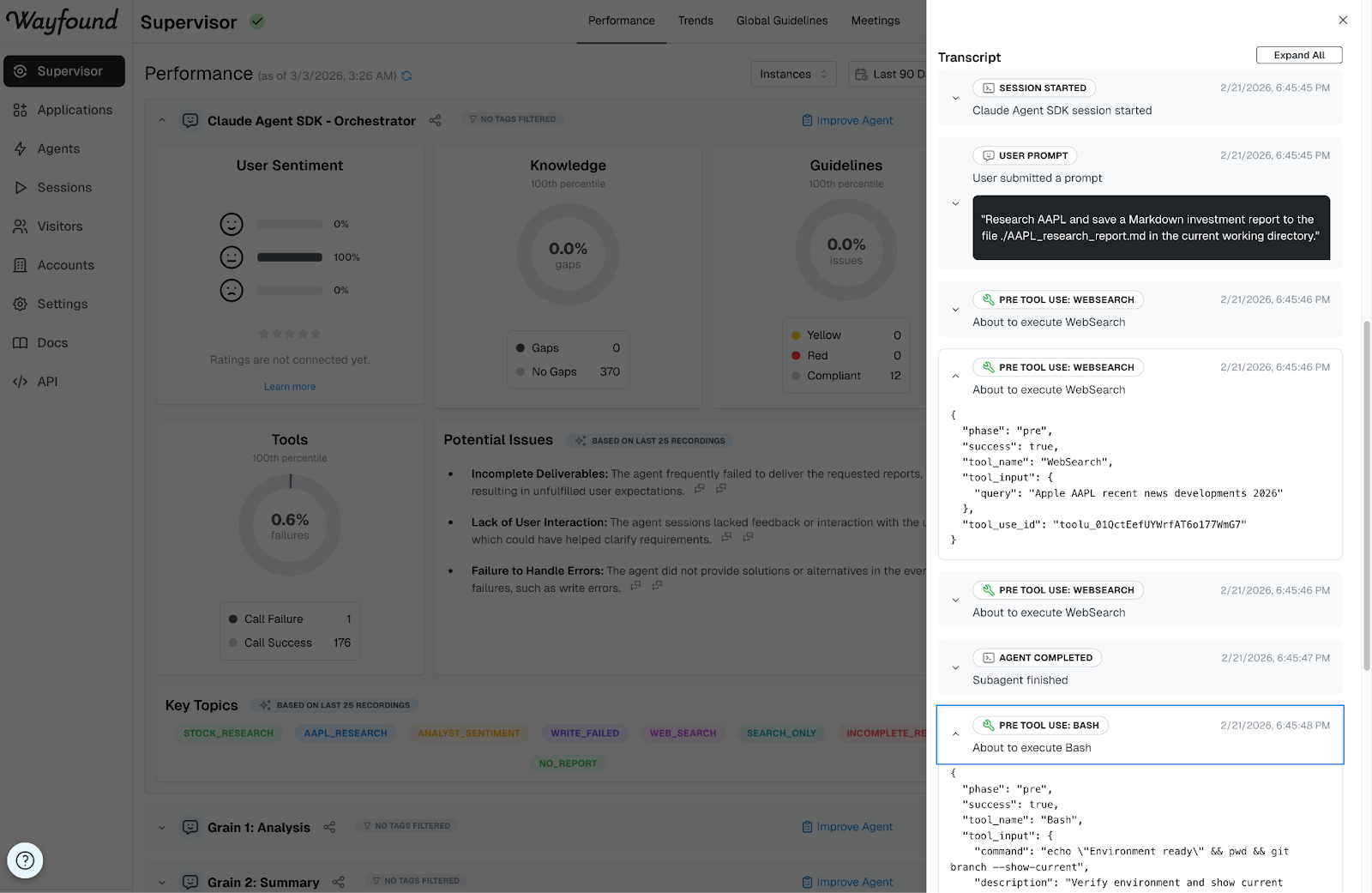
At session end, the plugin reads the complete session transcript and transforms it into structured events: user messages, assistant responses, tool calls and results, subagent invocations. It then posts the full event stream to Wayfound’s API in a single request.
The result is complete visibility into everything your agent did, thought, and produced, all available in Wayfound for analysis, supervision, and continuous improvement.
Built for Multi-Agent Systems
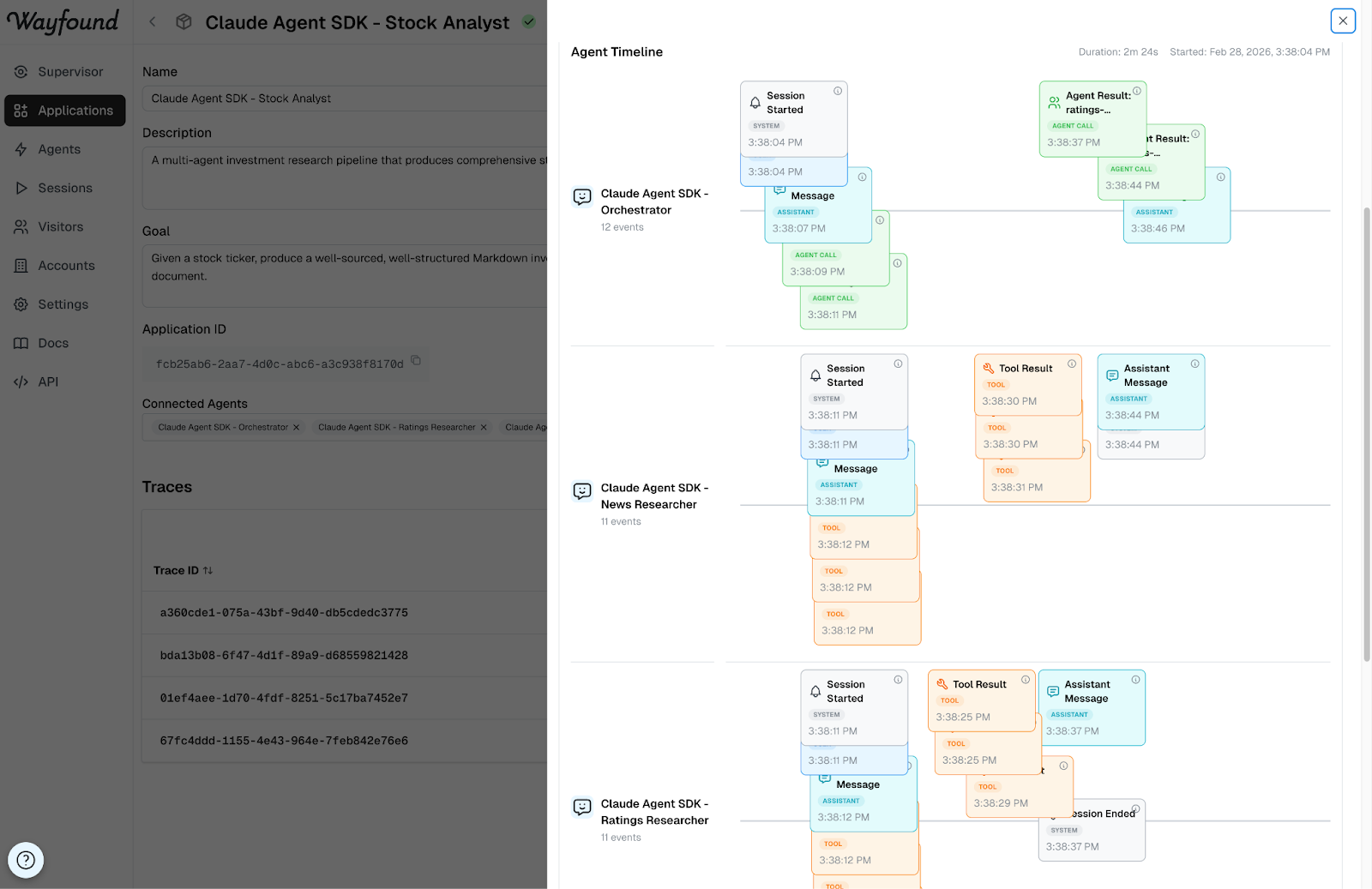
The plugin also supports multi-agent orchestration. The Claude Agent SDK supports spawning subagents through its Task tool. An orchestrator can delegate work to specialist agents that run their own sessions with their own tools and prompts. This is powerful, but it also means your system’s behavior is now distributed across multiple agents that may each need different supervision.
The plugin handles this natively. By default, subagent activity is inlined into the orchestrator’s session, giving you a unified view of the entire pipeline. But if you need per-agent supervision, say your research agent and your writing agent have different quality guidelines, you can route each subagent to its own Wayfound supervisor with a simple environment variable.
For teams running complex multi-agent applications, the plugin also supports application-level tracing. Set a single application ID, and all sessions within a run (orchestrator and subagents alike) are correlated with shared trace IDs and linked spans. This gives you end-to-end visibility across your entire agent system in Wayfound’s Applications view.
Why Open Source
We’re releasing this as an open-source project because we believe supervision should be a default, not an afterthought.
The barrier to getting started should be as low as possible. If you’re already building with the Claude Agent SDK, adding Wayfound supervision is a one-line plugin configuration and two environment variables. No SDK wrapping, no middleware, no code changes to your agents.
The plugin handles the plumbing (transcript parsing, event transformation, payload management, cross-platform compatibility) so you can focus on what matters: building agents that actually work well in production.
Getting Started
The plugin is open source and available on GitHub with two complete examples: a single-agent stock research tool and a multi-agent pipeline with parallel subagent orchestration. To use it, you’ll need a Wayfound account for the API key and agent configuration. You can request a trial to get set up, and from there both examples can be running against your own Wayfound workspace in minutes.