


What Are Guardian Agents? The New Supervision Layer for Agent Performance
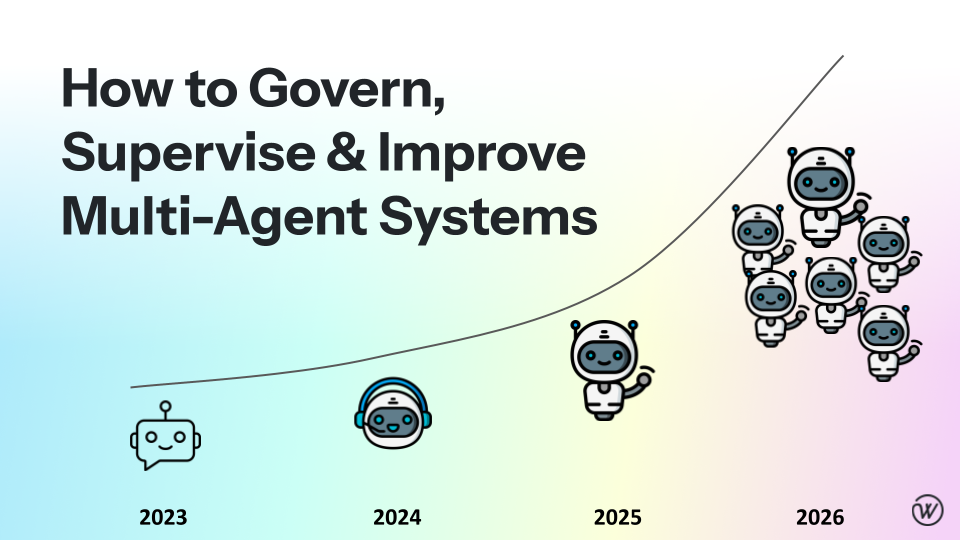

AI agents are moving fast from experiments to enterprise workflows. At O’Reilly’s Conference AI Superstream: Agent Orchestration (June 2026), the focus was on how companies can manage increasingly complex multi-agent systems, including handoffs, conflicting outputs, feedback loops, monitoring, and resilient execution. The event featured Wayfound CEO Tatyana Mamut’s keynote session, “How to Govern, Supervise, and Continuously Improve Multi-Agent Systems.”
AI Agents vs. Traditional Software
Her central point was simple: AI agents do not behave like traditional software, so they cannot be governed and managed like traditional software.
In traditional software, most of the work happens before deployment: build, test, release, then monitor for issues. But AI agents flip that lifecycle. Tatyana’s presentation shows the ratio shifting from an 80/20 build-and-test model to one where only 20% of the work happens before deployment and 80% happens afterward through monitoring, supervision, and improvement.
.jpg)
That shift is why AI agents require more than observability. They require a new management layer: guardian agents.
What Defines a Guardian Agent
That is why the rise of AI agents requires a new management layer: guardian agents. It's a category description coined by Gartner in late 2025.
A guardian agent, sometimes called a supervisor agent, is a high-level reasoning agent designed to oversee other AI agents as they operate. Unlike traditional observability tools, which are often built for engineering teams and focused on technical signals, guardian agents evaluate whether AI agents are actually doing the right work, in the right way, against the right goals.
That distinction matters. Technical monitoring can tell you whether an agent is running. It may show traces, errors, latency, or cost. But the business owner of an AI agent needs to know something different: Is the agent achieving the intended outcome? Is it following company policy? Is it creating a good customer experience? Is it improving over time?
What Must Guardian Agents Do
Tatyana put the work of these supervisor agents into three categories:
- Knowing "What Good Looks Like" = Traditional observability & eval platforms are single-turn, & binary, don’t learn company context, norms & standards across sessions. Supervisor Agents have their own memory and understanding of the company, its context & its policies to holistically reason about agent performance.
- Managing Guidelines as a Hierarchy = Guidelines need to be enforced hierarchically & independently, ensuring conflicts are resolved based on priorities spanning Legal/Compliance regulations, Company-wide policies, and Agent-specific roles and goals
- Applying Automations and Inputs to Improve Agents = Supervisor Agents think about “How can this agent be improved?” and generate suggestions for new directives and knowledge to ensure increasing agent & workflow compliance and performance. These suggestions can be automated via MCP, closing the improvement loop.
Who Needs and Benefits from a Guardian Agent?
Gartner has several sub-categories in its market report on guardian agents, but a key one is for business alignment and outcomes. Wayfound’s view is that AI agent supervision has to be accessible to the people accountable for real-world performance — not only the technical teams building and maintaining the agents. Its current positioning emphasizes “business-led agent supervision” and describes Wayfound as a Guardian Agent solution that tells business teams how agents are performing and how to improve them.
This shift becomes even more important as companies move from individual agents to multi-agent systems. In Tatyana’s presentation, she argues that organizations with many agents require a new agent supervision laye. These guardian agents do more than observe. They learn company context, policies, norms, and processes, then use that understanding to reason about agent performance across sessions.
They also enforce priorities. In the real world, not every rule has the same weight. Legal requirements may outrank company-wide policies, which may outrank agent-specific instructions. Guardian agents help resolve those conflicts by applying guidelines hierarchically and independently.
Most importantly, guardian agents close the improvement loop. They can read and analyze traces, sessions, and reasoning; alert teams or stop an agent when critical errors occur; decide what improvements would help the agent perform better; and hand off those improvements to coding agents for implementation.
That is the bigger paradigm shift. With traditional software, most effort happens before deployment. With AI agents, deployment is not the finish line. It is the point where the most important work begins: supervision, evaluation, and continuous improvement.
For companies scaling AI agents, guardian agents are becoming essential infrastructure. They give business teams the visibility to understand performance, the control to enforce standards, and the feedback loops to keep agents aligned with the outcomes they were built to deliver.
Because AI agents do not just need to run. They need to be managed.